How Do You Stop Garden Water Running Towards the House?
If rainwater is pooling against your house wall or submerging your air bricks, you need to intercept it before it breaches the damp-proof course. Stopping surface runoff comes down to three practical jobs: setting the right surface fall away from the brickwork, fitting a linear ACO channel drain along the threshold, and piping that water into a properly sited soakaway or rainwater drain.
The Short Answer: What Actually Fixes It on Site
1. Keep Below the DPC
Any patio, path, or driveway must finish at least 150mm (two brick courses) below your wall's damp-proof course. If someone has laid slabs directly over an old patio, digging it out to lower the height is often the first step.
2. Fit Linear ACO Channels
Where a garden or drive naturally slopes towards the house and cannot be re-graded away, we bed a polymer concrete ACO channel drain in concrete right along the wall line to catch water before it hits the masonry.
3. Give Water Somewhere to Go
A channel drain is useless if it isn't piped out properly. We connect the outlet either into an existing surface water gully (via a silt trap) or run underground UPVC pipework to a crate soakaway dug at least 5 metres clear of the foundations.
Why Does Water Pool Against the House in the First Place?
When we go out to inspect a flooded patio or a driveway that turns into a pond every autumn, the problem usually comes down to one of three things: heavy clay ground underneath, poor levels set by a previous installer, or blocked/unconnected drainage channels.
Across much of Greater Manchester and North Cheshire, the subsoil is thick, moisture-retentive clay. In summer it bakes hard, and through winter it holds onto water like a putty bowl. If a lawn or poorly laid patio slopes towards your back doors, that clay stops rainwater from soaking naturally into the earth. Instead, the water travels under the turf or paving bed and sits directly against your house footings.
The Danger to Foundations and Sub-Floors
Constant standing water against exterior brickwork does more than leave green algae on your slabs. If water sits high enough to splash above the damp-proof course—or pours straight through low-level sub-floor air bricks—you end up with damp internal plaster, rotting suspended timber joists, and frost damage to saturated bricks during winter freezes.Over time, concentrated water pooling in one spot can also wash fines out of the sub-base, causing the paving slabs or driveway blocks near the house wall to sink and tip inwards, which only pulls more water toward the brickwork.
Quick Signs Your Fall or Drainage Has Failed:
- Puddles sitting against threshold steps or bi-fold door tracks more than an hour after rain stops.
- Tide marks, green moss, or crumbling mortar along the bottom two courses of house brickwork.
- Paving slabs or block pavers near the house wall rocking underfoot or dipping towards the property.
- Existing plastic drain grates choked solid with soil and patio sand because they were never connected to an outlet pipe.
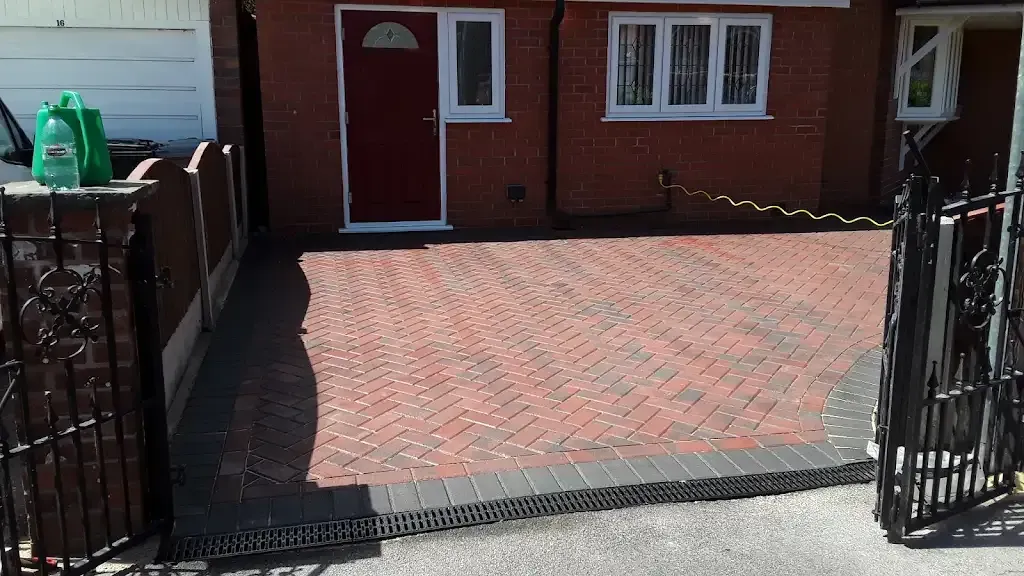
Linear drainage channels set cleanly along the perimeter of a block paved installation to capture surface runoff before it reaches the property wall or highway.
Need Your Levels Checked?
We carry out honest site assessments across South Manchester and surrounding areas. We check your damp course height, test the fall with a laser or spirit level, and give you a plain-English quote in writing.
View Our Groundworks & Drainage Service →Three Ways We Stop Water Running Towards Your Property
Every plot sits differently. On some properties we can re-grade the ground so water runs away naturally; on naturally sloping plots where the garden sits higher than the house, we build a physical barrier and drainage network to intercept the flow.
Correcting the Surface Fall (Cross-Falls & End-Falls)
Water needs a steady, consistent gradient to move without pooling. When laying Indian sandstone patios or block paving, we set string lines at a fall of roughly 1 in 60 to 1 in 80 (around 12mm to 16mm drop for every metre of paving).
Where possible, we grade the compacted MOT Type 1 sub-base and the mortar or sharp sand bed so water sheds away from the house towards a flowerbed, lawn border, or front perimeter drain. If a patio has been laid flat—or worse, tilted back toward the house—the only permanent cure is lifting the affected slabs, re-profiling the base, and relaying them to the proper line.
Installing Linear ACO Channel Drains
When the natural lie of the land slopes down toward the back of the house or garage door, you cannot fight gravity. Instead, we install heavy-duty linear ACO channel drains along the house wall or across the driveway threshold.
We dig a trench, pour a solid concrete bed (typically 100mm deep), and haunch the sides of the channel in concrete so it never rocks or sinks under foot or vehicle weight. The top of the removable grating is set 3mm to 5mm below the adjacent paving edge so water drops cleanly into the trough instead of skipping over the top.
Compliant Soakaways & French Drains
Under UK Sustainable Drainage Systems (SuDS) rules for front gardens over 5 square metres, and Building Regulations for surface water, you cannot simply let runoff pour out onto the public pavement or connect a huge new patio straight into a foul sewer without permission.
Where there isn't a dedicated surface water gully to tie into, we excavate a deep pit at least 5 metres away from the house foundations and install modular plastic attenuation crates wrapped in a non-woven geotextile membrane. For waterlogged lawns running down to a patio edge, we also install perforated land drains (French drains) backfilled with washed 20mm shingle to intercept groundwater before it hits the slabs.
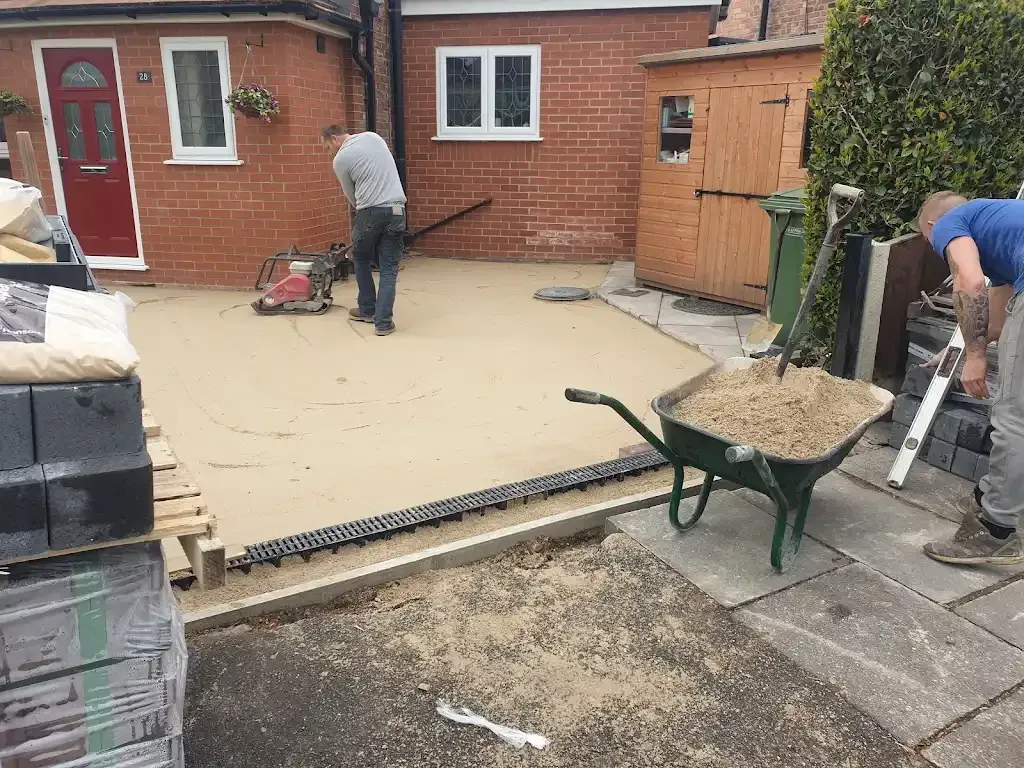
Proper sub-base compaction and drainage preparation on site—getting the levels right in the hardcore layer prevents future dips and standing water.
Repair vs Full Relay: What Does the Job Actually Involve?
Homeowners often ask if they have to rip up their entire driveway or patio just to stop water pooling by the house. The honest answer depends on how the rest of the paving is holding up.
When a Targeted Retro-Fit Works
If your existing driveway or patio is structurally solid and already slopes towards the house in one smooth plane, we don't need to dig the whole thing up. We can diamond-cut a neat channel strip along the brickwork or garage door, excavate the trench, bed a new ACO drain line, and pipe it into your rainwater gully or a new garden soakaway. A targeted drainage retrofit typically takes 1 to 2 working days.
When You Need Excavation & Relaying
If water is pooling in dish-shaped hollows in the middle of the paving, or if the slabs were laid straight onto dirt with no MOT Type 1 sub-base, fitting a drain at the edge won't empty the puddles in the middle. In that case, we lift the sunken area, dig out the soft clay to 200mm–250mm, lay geotextile membrane and compacted Type 1 aggregate, and relay the surface to a true fall over 3 to 5 working days.
A quick tip on maintenance: Whenever we fit linear channel drains, we install a removable silt bucket or leaf trap at the outlet end before the pipe goes underground. Lifting the grate once or twice a year to scoop out dead leaves and roof grit stops the underground pipe from silting up.
Related Services & Guides
Explore our groundwork services and practical advice for looking after your driveway, patio, and garden drainage.
Groundworks And Drainage in Stretford
Expert ground excavation and surface water drainage in Stretford. Site clearance, MOT sub-base prep, and ACO channel installs by Insight PS Limited.
Do I Need Planning Permission to Pave My Front Garden?
Learn the UK planning rules for paving a front garden. We explain the 5m² SuDS rule, permeable surfaces, soakaways, and council dropped kerb permits.
How Long Does It Take to Lay a New Patio?
Most garden patios take 3 to 7 working days to lay. See our day-by-day schedule covering excavation, Type 1 sub-bases, mortar bedding, and curing times.
Real Turf or Artificial Grass: Which Is Best for Clay?
Compare real turf and artificial grass on heavy clay soil. Learn about sub-base depths, drainage, pet suitability, and stopping winter waterlogging.
Are Concrete Fence Posts Better Than Wooden Ones?
Compare concrete fence posts with gravel boards against treated timber posts. Learn about lifespan, wind resistance, costs, and stopping ground-level rot.
Why Are My Patio Slabs Loose and Rocking?
Find out why natural stone patio slabs work loose over time and how lifting, cleaning, and re-bedding them on a full wet mortar bed with SBR fixes the issue.
Got Standing Water Against Your House or Driveway?
Speak directly with our family-run team at Insight PS. With over 25 years of hands-on groundwork experience across Manchester and the surrounding 30-mile radius, we will inspect your levels, explain the fix plainly, and provide a free, no-obligation written estimate.