How Long Does It Take to Lay a New Patio?
For an average-sized domestic patio (around 25 to 40 square metres), a proper installation takes between 3 and 7 working days from bringing in the digger to the final sweep-down. Plus, you will need to allow an extra 24 to 48 hours of drying time before walking or putting garden furniture on the new slabs.
3–4 Days
Straightforward layout with good side access for machinery.
4–6 Days
Includes drainage channel fitting, steps, or recessed manhole covers.
7–10 Days
Often involves brick retaining walls, sleeper beds, and complex cuts.
24–48 Hours
Keep off the slabs after jointing so the mortar bed sets rock solid.
What Happens Each Day on Site?
When homeowners ask why a patio takes a full working week, the honest answer is that the slabs themselves are only the final 20% of the job. Most of the graft goes into what is underneath. If a contractor promises to rip out your old flags and lay a new patio in a day and a half, they are almost certainly skipping the excavation depth or laying slabs on "spots" of mortar—which leads to rocking stones and puddles within a single winter.
Here is how a standard 5-day patio installation runs when we do the job properly from the ground up.
Site Protection, Mechanical Dig-Out & Spoil Removal
Before a single spade hits the dirt, we lay heavy-duty timber boards along your side access path or front driveway so our wheelbarrows and narrow-access tracked digger don't mark your existing surfaces. We then break out any old concrete or flagging and dig down roughly 150mm to 200mm below the finished patio height.
In the North West, we frequently hit heavy, wet clay subsoil a few inches below the turf. Clay holds water and shifts seasonally, so we don't take shortcuts on depth. For an average garden, digging out creates 6 to 10 tonnes of heavy soil and rubble, which is barrowed straight into a skip or grab wagon and removed under registered waste transfer notes.
Geotextile Membrane, Drainage Channels & MOT Type 1 Sub-Base
Once the trench is level and set to a slight fall (usually a 1-in-60 or 1-in-80 gradient so rainwater runs away from your house brickwork), we roll out a heavy-duty geotextile membrane. This stops the stone base from sinking into the clay below.
Next, we set any concrete edge restraints, recessed manhole frames, and linear ACO drainage channels along the house wall, making sure the finished patio sits at least 150mm (two brick courses) below your damp-proof course. We then wheel in MOT Type 1 crushed limestone hardcore, raking it out and compacting it in layers with a heavy mechanical wacker plate until we have a solid 100mm sub-base that won't budge.
Full Wet Mortar Bedding, SBR Slurry & Stone Cutting
With string lines taut to guide our heights and falls, we start laying the paving. We never dot-and-dab slabs on five blobs of cement. Every single Indian sandstone or natural stone slab is laid onto a full, continuous 40mm to 50mm wet sharp-sand and cement mortar bed.
Because natural stone and porcelain can be smooth or dusty underneath, we brush an SBR latex bonding slurry primer onto the back of each slab just before tapping it down with a rubber mallet. This creates a chemical bond between the stone and the mortar bed so slabs never come loose or hollow out when frost hits. Perimeter cuts around drainpipes, steps, and curved borders are done using a water-fed Stihl diamond disc cutter to keep dust down.
Pointing the Joints, Site Wash-Down & Handover
Once the mortar bed has firmed up overnight, we point the joints between the slabs—either using a traditional trowelled sand-and-cement mortar mix or a two-part permeable resin jointing compound that resists weed growth and pressure washing. Finally, we wash down the stone, lift our protective boards, sweep the driveway clean, and arrange for the skip to be collected.
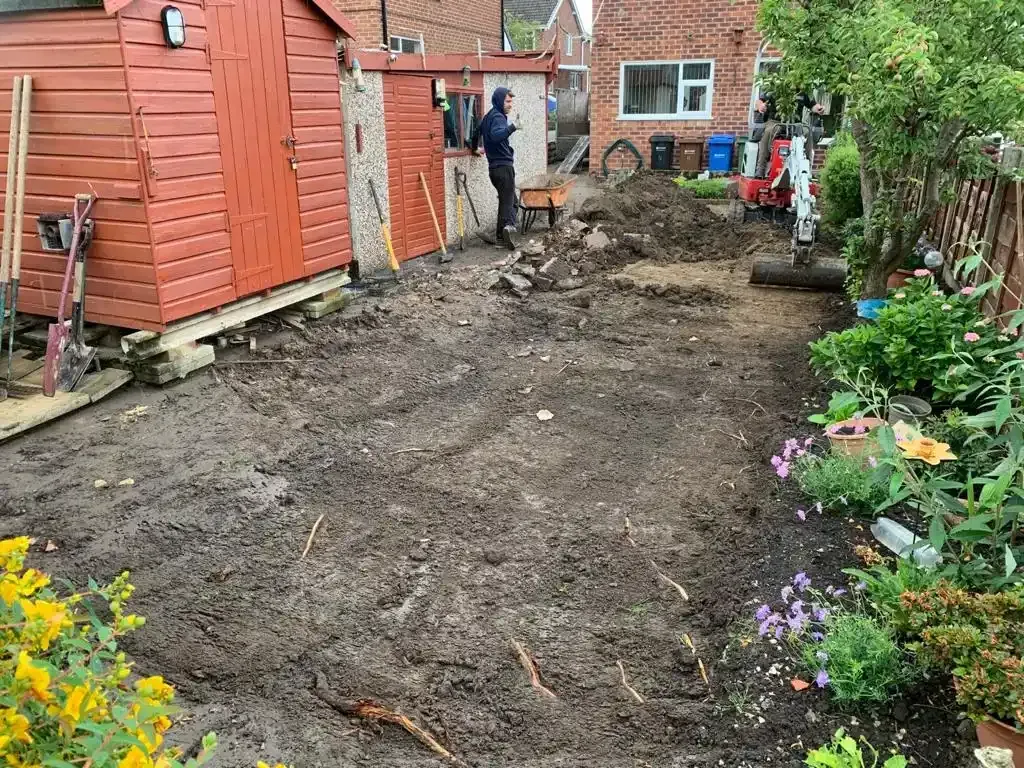
Stage 1: Excavation
Clearing old turf and clay subsoil with a compact mini-excavator to reach solid bearing ground.
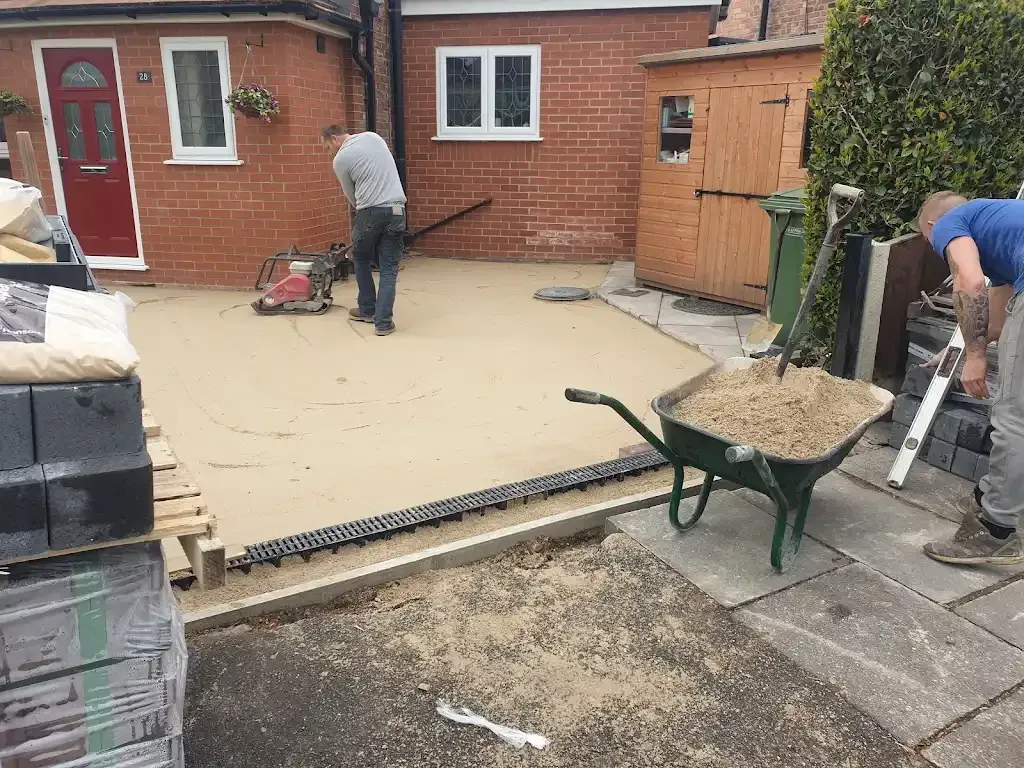
Stage 2: Compaction & Drainage
Compacting the aggregate sub-base with a heavy plate compactor and setting linear drainage channels.
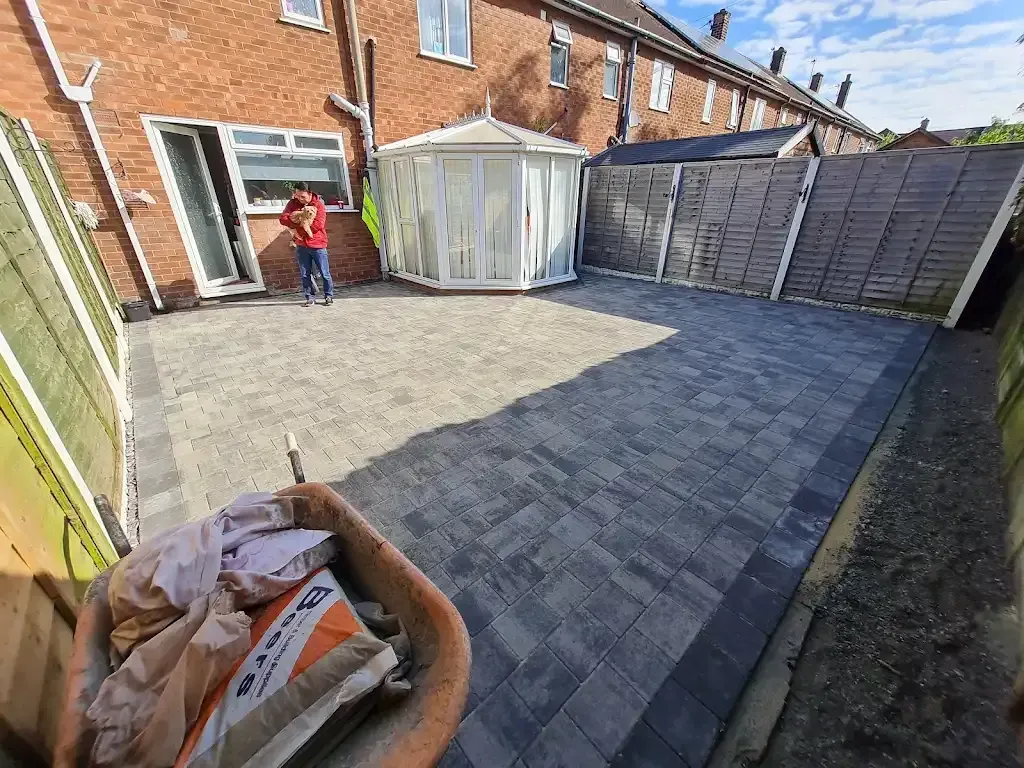
Stage 3: Finished Surface
Neat perimeter haunching, crisp joints, and a clean wash-down ready for curing.
What Can Add a Day or Two to the Schedule?
Every back garden has its own quirks. When we come out to measure up and put together your written quote, we look at three practical things that determine whether your patio is a 3-day job or a 7-day job.
Garden Access & Skip Permits
If you have a wide side gate where we can track a micro-digger through, excavation takes a single day. If your property is a terrace with narrow ginnel access or shared passageways, we have to dig by hand or use slimline barrows, which naturally adds a day.
Likewise, if you have room on your driveway for the skip, we can drop it the morning we start. If the skip has to go out on the public road, local councils (such as Manchester City Council or Trafford Council) require a highway skip permit, which needs to be booked a few days ahead of the start date.
Breaking Thick Concrete & Drainage Runs
Lifting old concrete council flags on sand is quick work. Breaking out a 6-inch-thick reinforced concrete base with heavy-duty hydraulic breakers takes extra time and an additional skip load.
If your garden slopes toward the back of the house, we also build in time to lay linear ACO channel drains and pipe them into an existing surface water gulley or dig a compliant garden soakaway well clear of the house foundations.
Rain, Frost & Mortar Curing Times
We can dig out and compact MOT Type 1 stone in typical Manchester drizzle without any trouble. However, we will never lay natural stone on wet mortar during heavy downpours or when overnight temperatures drop below 3°C, as frost ruins fresh cement and rain washes out jointing compounds.
Once the slabs are down and pointed, keep pets and foot traffic off for 24 hours in warm weather, or 48 hours in cooler spring and autumn weeks, before putting heavy tables or planters back out.
How You Can Help Keep the Job on Schedule
We handle all the heavy lifting, materials, and waste removal, so you don't need to do any groundwork yourself. A few simple steps the evening before we arrive help us get straight to work on Day 1:
- ✓ Clear garden furniture, barbecues, and plant pots off the existing patio area.
- ✓ Unlock side gates and move wheelie bins out of the side passageway.
- ✓ Leave space on the drive (or outside the front) for our skip and aggregate drop.
- ✓ Check that your outside tap is turned on so we have water for mortar mixing and dust suppression.
Planning a New Patio?
We provide free, written, no-obligation quotes across South Manchester, Stretford, Trafford, and surrounding areas.
Book a Free Site SurveyRelated Services & Guides
Patios & Garden Pathways in Stretford
Expert Indian sandstone and natural stone patio installation in Stretford. From site excavation to proper drainage, we build durable garden pathways.
Do I Need Planning Permission to Pave My Front Garden?
Learn the UK planning rules for paving a front garden. We explain the 5m² SuDS rule, permeable surfaces, soakaways, and council dropped kerb permits.
Real Turf or Artificial Grass: Which Is Best for Clay?
Compare real turf and artificial grass on heavy clay soil. Learn about sub-base depths, drainage, pet suitability, and stopping winter waterlogging.
Are Concrete Fence Posts Better Than Wooden Ones?
Compare concrete fence posts with gravel boards against treated timber posts. Learn about lifespan, wind resistance, costs, and stopping ground-level rot.
How Do You Stop Garden Water Running Towards the House?
Learn how to stop patio and driveway water pooling against your walls using ACO channel drains, correct surface falls, and properly sited soakaways.
Why Are My Patio Slabs Loose and Rocking?
Find out why natural stone patio slabs work loose over time and how lifting, cleaning, and re-bedding them on a full wet mortar bed with SBR fixes the issue.
Want an Honest Timeline & Written Quote for Your Garden?
With over 25 years of hands-on groundwork and paving experience from our Chorlton-cum-Hardy base, we build Indian sandstone, natural stone, and block paved patios properly from the sub-base up. Give our family-run team a ring to arrange a convenient time for a free measure-up.